
The Mirror Trick That Stopped Me Buying Sunglasses That Looked Wrong
I used to buy sunglasses the way I bought gas station snacks, fast and without trying them on properly. My drawer holds five pairs I regret. After enough returns, I figured out that face shape is a useful guide but only one piece of it, and that fit matters just as much. I’m no optician, so take this as one person’s trial and error. The sections below cover finding your shape, matching frames to it, and the fit checks that decide whether a pair stays.
Figure Out Your Shape Before You Shop

Most advice sorts faces into oval, round, square, heart, and diamond. Real faces mix these, and mine sits somewhere between oval and square depending on the light. Still, a rough label helps you narrow a wall of frames into a handful.
Here’s how I check mine. I pull my hair back, stand in front of a bathroom mirror, and trace the outline of my face on the glass with a dry-erase marker. Step back and look at what you drew. Is the jaw wider than the forehead, or the other way around? Are the cheekbones the widest point? Is the shape longer than it is wide? A phone selfie held at arm’s length works too, though a wide-angle lens distorts things, so I hold it farther back than feels natural.
Roughly, here’s what I’ve learned to look for:
Round faces are about as wide as they are long, with soft edges and few angles. Square faces have a strong jaw and a forehead of similar width. Oval faces are a bit longer than wide, with a gently curved jaw. Heart-shaped faces are broadest at the forehead and taper to a narrow chin. Diamond faces are widest at the cheekbones, with a narrower forehead and jaw.
Don’t treat your label as a rule. I’ve seen people with round faces look great in round frames, because the frame was the right size and sat in the right place. The labels are a starting point for contrast, where an angular frame can balance a round face and a curved frame can soften a sharp jaw. Plenty of people ignore that and look fine.
Try a few pairs outside your label on purpose. I do this every time, because I’ve been surprised more than once. The pair I wear daily is one I’d have skipped if I’d followed the chart.
Take your own photo in each pair, too. The mirror flatters me more than a camera does, and a quick snapshot shows how the frame looks to other people, not to the person who is staring at himself and hoping.
Match Frames to the Shape You Found
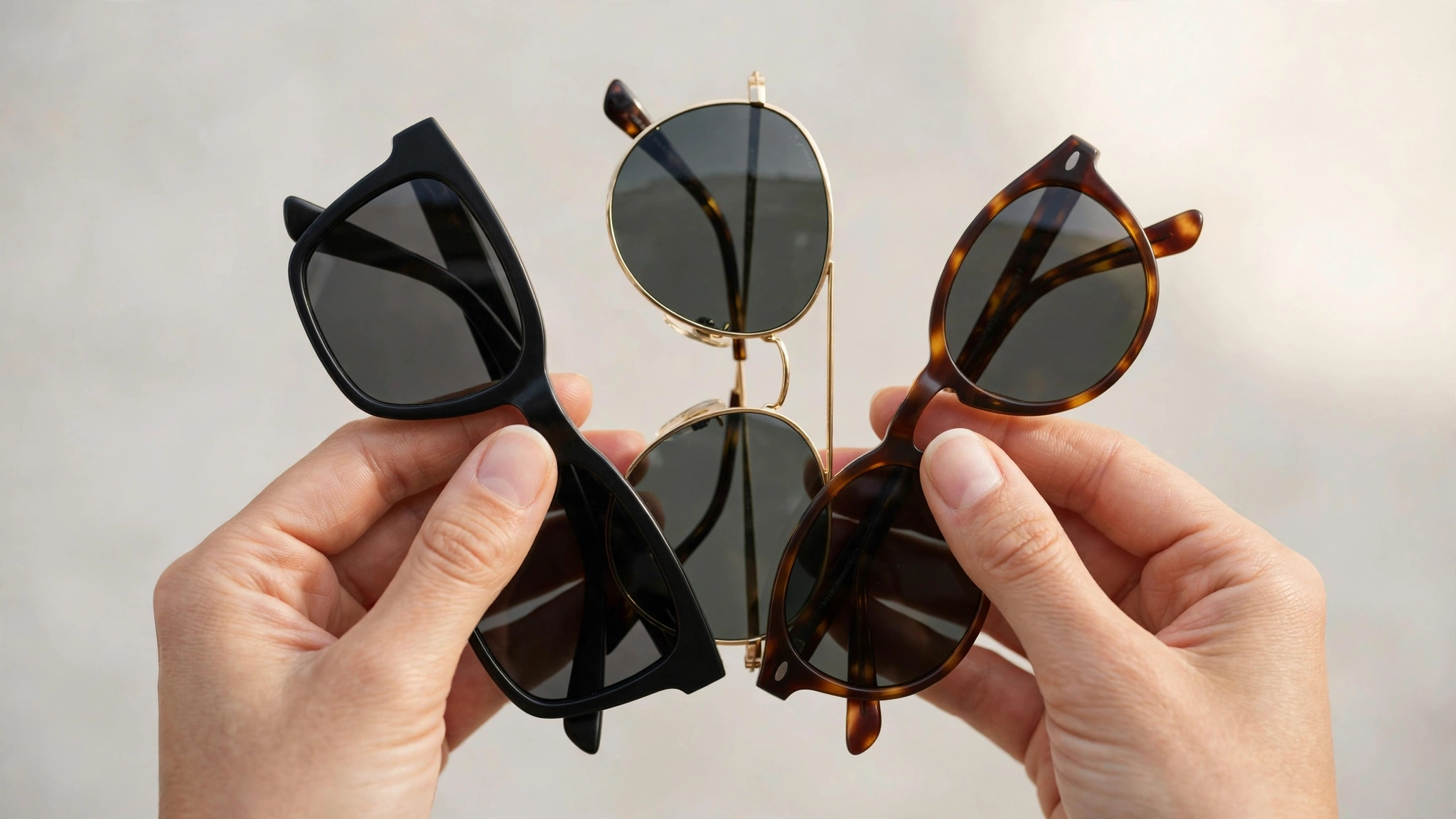
Once I had a rough label, I started matching. The idea is contrast and balance, and I use it loosely.
For round faces, angular and rectangular frames add definition. Wayfarer-style shapes, like the Ray-Ban Wayfarer, tend to work well, since the squared top line sharpens a soft outline. I avoid tiny round lenses on a round face, because they can echo the curve and make it feel more circular.
For square faces, I look at rounder shapes. Aviators and rounded oval frames soften a strong jaw. Thin metal frames feel lighter than chunky plastic ones here, and a frame that’s too wide for the face can exaggerate the corners.
For oval faces, almost anything works, which is the lucky draw. I’d still pay attention to proportion. A frame shouldn’t be much wider than the widest part of the face, and it shouldn’t swallow the cheeks.
For heart-shaped faces, I look for frames that are lighter at the top and fuller at the bottom, like rounded-bottom styles or aviators with a thin upper bar. Heavy browlines widen the forehead further. Rimless or light metal frames keep things balanced.
For diamond faces, the cheekbones carry the look, so I choose frames that echo that width, like cat-eye shapes or oval frames with a slightly upswept line. Narrow frames can make the cheekbones look wider than they are.
Color matters less than shape. Black and tortoiseshell go with most things, and a thin gold or silver metal frame suits a lighter, quieter look. I’d match the metal to whatever jewelry or watch I wear most, though it’s a minor point.
Size sits inside all of this. Frame width should roughly match the width of your face, with the edges landing near your temples. Most pairs list measurements on the inside of the arm, three numbers like 52-18-140. The first is lens width in millimeters, the second is the bridge, and the third is the arm length. Once I found a pair that fit well, I copied those numbers whenever I shopped online. It’s the single most useful thing I did.
Fit Checks That Beat Any Chart

Face shape got me into the right aisle. Fit decided which pair I took home. I run the same four tests in every store.
First, the nose bridge. The sunglasses should rest on your nose without pinching or sliding down when you look at the floor. Lean forward and shake your head gently. If they drift, they’ll drive you crazy on a bike or a windy day. Plastic frames can’t be adjusted much, while metal ones with adjustable nose pads can be bent by an optician in a minute.
Second, the temples. The arms should hold lightly without squeezing the sides of your head. If you feel a headache starting in the fitting room, it won’t improve later. Frames that sit too tight leave red marks behind the ears by mid-afternoon.
Third, eyebrows and cheeks. The top of the frame should follow the line of your brows, not cover them or sit far above. At the bottom, the lenses shouldn’t rest on your cheeks, because every smile will push them up. Smile at yourself in the mirror to check.
Fourth, coverage. Wrap-style or larger lenses block more light at the sides, which matters for driving, running, and long days outdoors. Look for UV400 protection or a label saying 100 percent UV protection. Dark tint alone doesn’t guarantee that, and a dark lens without UV protection can be worse than none, since your pupils open wider. Polarized lenses cut glare off water and roads, and I use them for driving, though they can make some phone and dashboard screens look odd.
Price barely tracked quality in my experience. Some inexpensive pairs from Goodr and Knockaround fit me better than costly ones. A midrange pair from a brand like Warby Parker let me order several frames at home and try them on in my own mirror, which suited me.
Last summer I left a pair on a train, bought the same style again, and it sat the same way on my face. That’s how I knew the numbers on the arm were doing their job.