The Half-Inch Hem That Fixed Every Outfit I Owned
I’m five feet tall, and for years I assumed clothes were the problem. They weren’t. Proportions were. A jacket that ends at the hip on a taller woman ends at my thigh, and a standard inseam pools at my ankles. After a lot of fitting-room frustration and a tailor who became a friend, I settled on three outfits that work on a short frame. I’m describing my own experience, and bodies vary, so adapt what fits you.
High Waist, Tucked Top, Straight or Slightly Cropped Leg

The fastest way I found to look longer through the legs is to raise the waistline. A high-rise pair of jeans or trousers puts the visual break higher on my body, so the legs read as a bigger share of my height. Mid and low rises cut me in half at an awkward spot.
My base is a pair of dark straight-leg jeans with a high rise, and the hem is where the whole outfit lives. Standard jeans run 30 to 32 inches long on the inseam, which is too long for me. I take mine to a tailor to shorten them, and I ask for the original hem to be kept if the jeans have a distinctive finish, which adds a little to the cost but looks far better than a plain chopped cuff. Brands like Madewell and Levi’s sell petite lengths, and Levi’s 501s in a shorter inseam saved me the trip.
The cuff should land at the ankle bone or just above it. That small flash of skin elongates the leg. If you prefer full length, the hem should just graze the top of the shoe, and a pooling hem shortens everything.
On top, I wear a fitted tee or a thin knit and tuck it in fully. A French tuck, where only the front is tucked, works too, and it shows the waistline without bulk. Heavyweight cotton like a Hanes Beefy-T holds its shape and doesn’t cling. I avoid anything with a long, loose hem, because extra fabric below the waist eats up the length I’m trying to build.
A belt in the same color family as the jeans or in a thin brown leather keeps the line unbroken. Wide, contrasting belts cut me into sections, so I save them for days when I want that effect.
Shoes matter here more than anywhere. Pointed flats and loafers extend the leg line, as do low-profile white leather sneakers with a slim sole. Chunky sneakers can look great, though they sometimes make my legs look shorter by weighing down the bottom.
I wore this outfit to a long afternoon of errands and an unplanned dinner, and it held up for both. When something works on a short frame, it usually works because of the waist and the hem, and I check those two things before I check anything else.
One Color Head to Toe, With a Cropped Layer

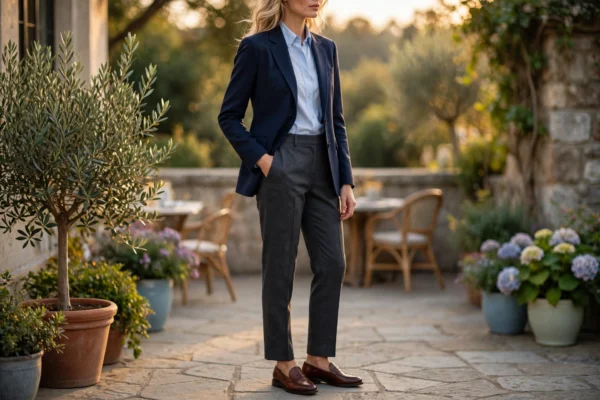
The second outfit uses a single color from shoulders to shoes, which draws a long vertical line and avoids chopping the body into blocks. I usually pick navy, charcoal, or cream.
My favorite version is navy: a navy merino crewneck, navy trousers with a straight leg, and dark leather shoes. The shades don’t need to match exactly, since a lighter top over a darker bottom looks intentional, while near-matches look like a mistake. Merino resists odor, so I wear the sweater a few times before washing it cold and drying it flat.
The layer on top is what makes the outfit work for my height. Long coats and oversized jackets swallow me. Instead I wear a cropped or short jacket that stops at the hip bone or just above it, such as a short chore coat or a trim blazer. Pairing it with high-waisted trousers keeps the proportions balanced: short on top, long on the bottom.
Fit decides everything with jackets. The shoulder seam should sit at the edge of your shoulder, and sleeves should end at the wrist bone. A tailor can shorten sleeves, but shoulders are nearly impossible to fix. I learned that after buying a blazer that was a little too wide, wearing it twice, and giving up on it. Shopping the petite section helps, because those jackets are cut with shorter sleeves and a higher button placement, though you still have to try them on.
Monochrome doesn’t have to mean boring. Texture does the work, so I mix smooth wool with ribbed knit, or cotton with leather. A thin belt, a small watch, or a scarf in the same color family adds interest without breaking the line.
I also wear the same trick in cream, which looks softer and a bit brighter. Cream shows dirt, so I spot-clean with a damp cloth right away and keep it away from the pen in my bag. A heavier fabric hides marks better than a thin one.
If I add a contrasting color, it goes near my face, like a scarf, and the long line below stays unbroken. A white collar or a cream scarf brightens everything and draws the eye upward, which helps with height too.
Dresses and Skirts That Stop at the Right Spot

The third outfit is for days I want something simpler than separates. Hem length is the whole game here, and I got it wrong for years.
The spot that works best on me is just above the knee, or a midi that lands at the narrowest part of my calf. A hem that stops mid-calf, at the widest point, makes my legs look shorter. I tried a mid-calf skirt once, and in the mirror it looked like I’d borrowed it from someone taller. Hemming it up two inches changed the whole thing.
A wrap dress or a dress with a defined waist works on my frame, because it marks a clear waistline and keeps the skirt from hanging like a sack. V-necks and open collars lengthen the neck and upper body. I look for fabrics with some drape, like jersey or crepe, since stiff, voluminous skirts overwhelm me. Prints should be small or medium. A large pattern can swallow a short frame, though I’ve seen it done well, so I don’t treat it as a rule.
Shoes complete the line. Nude or skin-toned flats and pointed toes extend the leg, while a heel of an inch or two adds height without wobbling. Ankle straps cut the line, so I skip them or choose a slim one. Block heels are comfortable, and a thin stiletto looks lovely at dinner and miserable on a long walk.
On cooler days I add a cropped denim jacket or a short knit cardigan, never a hip-length layer that cuts the dress in half at the wrong spot. For colder weather, a coat that ends at the knee or above works better than a long one, and I check that the sleeves don’t bunch at my wrists.
For a dress, tailoring matters even more than for trousers. Shortening a hem is one of the cheapest fixes a tailor does, and taking in the waist or shoulders costs a bit more. I look for dresses with enough fabric in the seams to make adjustments, which I check by turning the garment inside out.
Last month I wore a dress I’d nearly donated, after a quick hem. Somebody asked if I’d gotten taller, and I said the tailor did it.