
The Backward Hanger Trick That Emptied Half My Closet
Two years ago I opened my closet, counted 90 pieces, and realized I wore the same handful every week. I’m no strict minimalist, and I still own a hat collection nobody asked for. But a smaller wardrobe built around dependable core pieces made mornings faster and shopping less impulsive. Here’s the process I’d hand to a friend starting from scratch, in the order I’d do it, before spending a dollar.
Start by Flipping Every Hanger
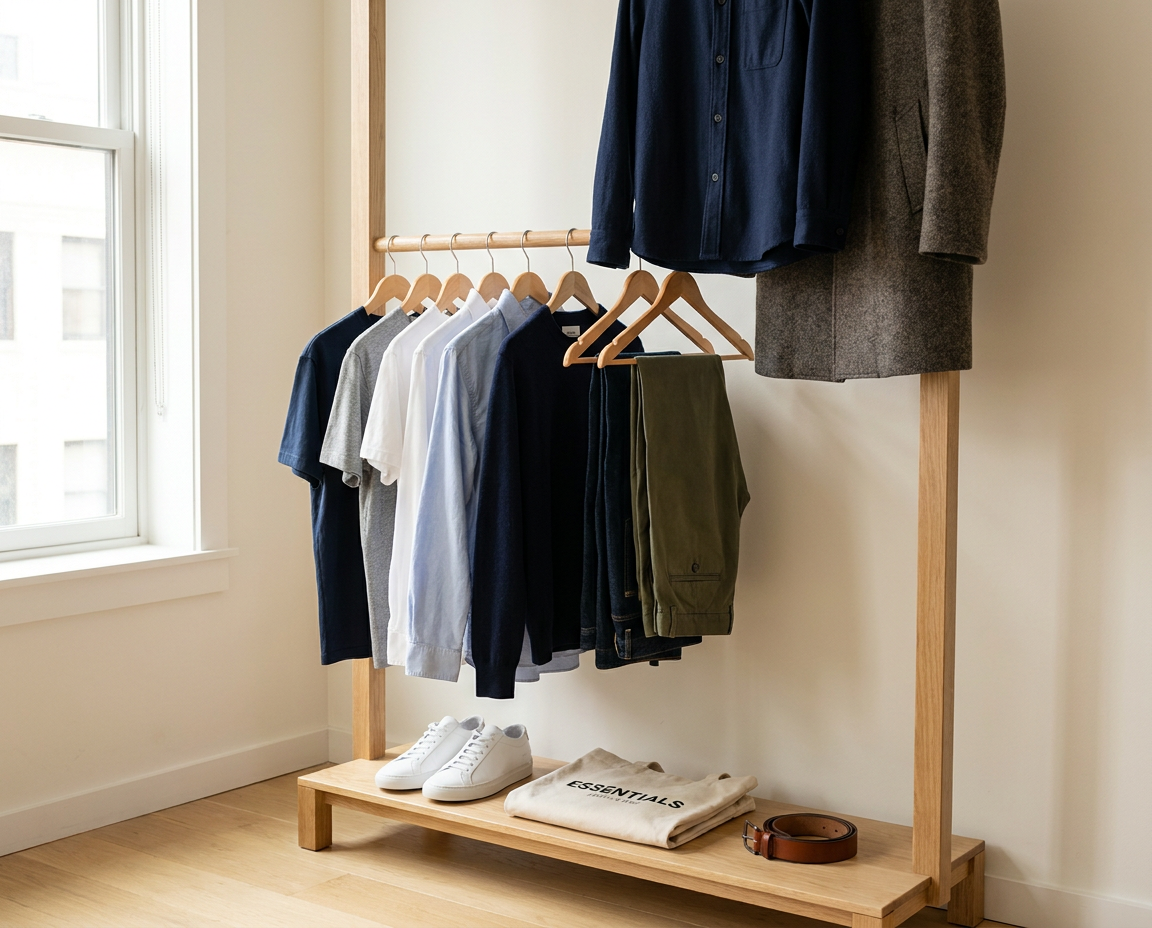
Before you buy anything, find out what you already wear. Turn every hanger in your closet so the hook faces the opposite way from normal. When you wear something and hang it back up, put it on the hanger the regular way. For folded clothes I stuck a strip of masking tape on the shelf edge and moved worn items in front of it.
After about ten weeks, nearly half my closet still hung backward, which was humbling. Three sweaters were in constant rotation, while a row of shirts I’d bought for a version of myself who went to more dinners had never moved. Jeans were the worst. I owned seven pairs and wore two.
Give it a full season change if you can. A wool coat looks unworn in August and that doesn’t mean it should go. I handled that by setting aside seasonal pieces and formal one-offs, like a suit or a single dress shirt for weddings, and judging them separately. Everything else got judged by what the hangers said.
What you do with the backward pile matters more than people admit. I made three bags. One was for friends or a donation bin, one was for things that needed repair or hemming, and one was for items I wasn’t ready to let go of. That last bag lived in my car trunk for a month. If I needed nothing from it, it left, and only one jacket made it back inside.
I also wrote down what I reached for most. My phone note listed five things and why: a gray crewneck sweatshirt, a navy overshirt, straight dark jeans, a white tee, and Adidas Samba sneakers. Every one was soft or easy to move in, and every one was a neutral. That list shaped my shopping better than any article could.
A few things surprised me. I’d kept a scratchy but handsome wool sweater for a year because it was expensive, and I’d worn it twice. Shoes that pinched in the store pinched at home too, and they were at the bottom of the backward pile. Price had nothing to do with what I actually put on.
The Checklist, Sorted by Color
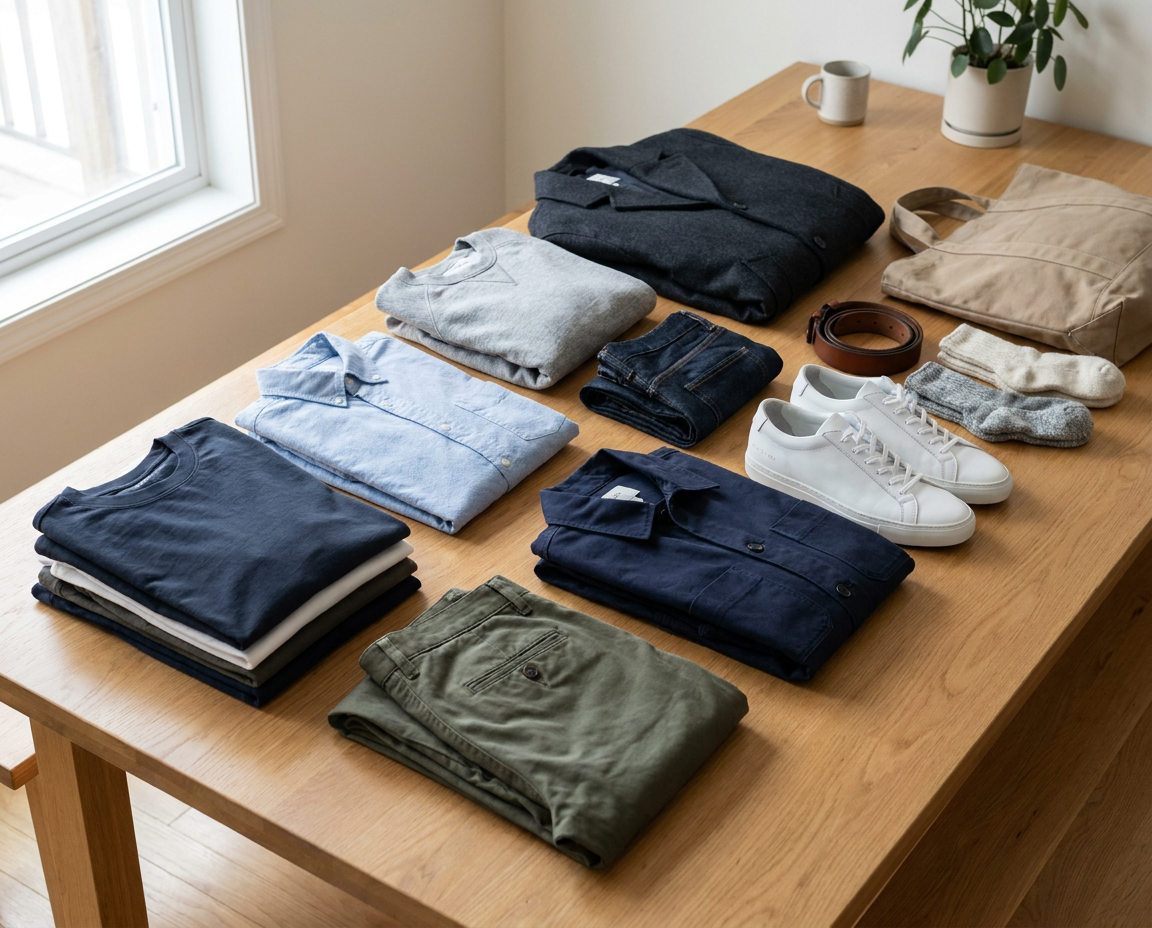
I stick to two base neutrals and one accent. Mine are navy and gray, with olive as the accent, but black and cream or brown and white work the same way. Everything below mixes with everything else, which is the whole point.
Tops (5): a white crewneck tee, a gray tee or long sleeve, a light blue oxford shirt, a navy crewneck sweater, and a gray sweatshirt. I buy heavy cotton tees because thin ones turn see-through after a few washes. Hanes Beefy-T and Fruit of the Loom both hold up. The oxford’s bumpy weave hides wrinkles better than poplin does, so it survives a day in a bag.
Bottoms (4): dark straight-leg jeans, olive or khaki chinos, black wool-blend trousers, and one pair that suits your climate, either shorts or lighter-wash jeans. Straight legs go with every shoe I own, so I stopped chasing trends there.
Layers (2): an unstructured navy blazer or overshirt, and a coat roomy enough to wear over a sweater. Try the coat on with the sweater, not just a tee, or it will feel tight by November. If you live somewhere rainy, a packable shell like the Patagonia Torrentshell earns a slot too, since cotton trench coats soak through.
Shoes (3): white leather sneakers, brown leather boots or loafers, and one pair built for weather or long walks. Blundstones handle puddles better than anything else I’ve worn.
Small things: a brown leather belt, wool socks (Darn Tough guarantees theirs, which sold me), and a canvas tote that replaces a backpack on most days.
That comes to about 17 pieces, and the count isn’t the interesting part. The combinations are. Five tops and four bottoms give you 20 outfits before a single layer, and the layers multiply that again. I stopped thinking in items and started thinking in how many different ways each one could be worn.
I left one slot open for something I simply love. Mine is a rust-colored corduroy shirt that doesn’t fit the palette at all. It stays because I wear it constantly, and that’s the only rule it has to meet.
Fit, Fabric, and the Thirty-Day Wait
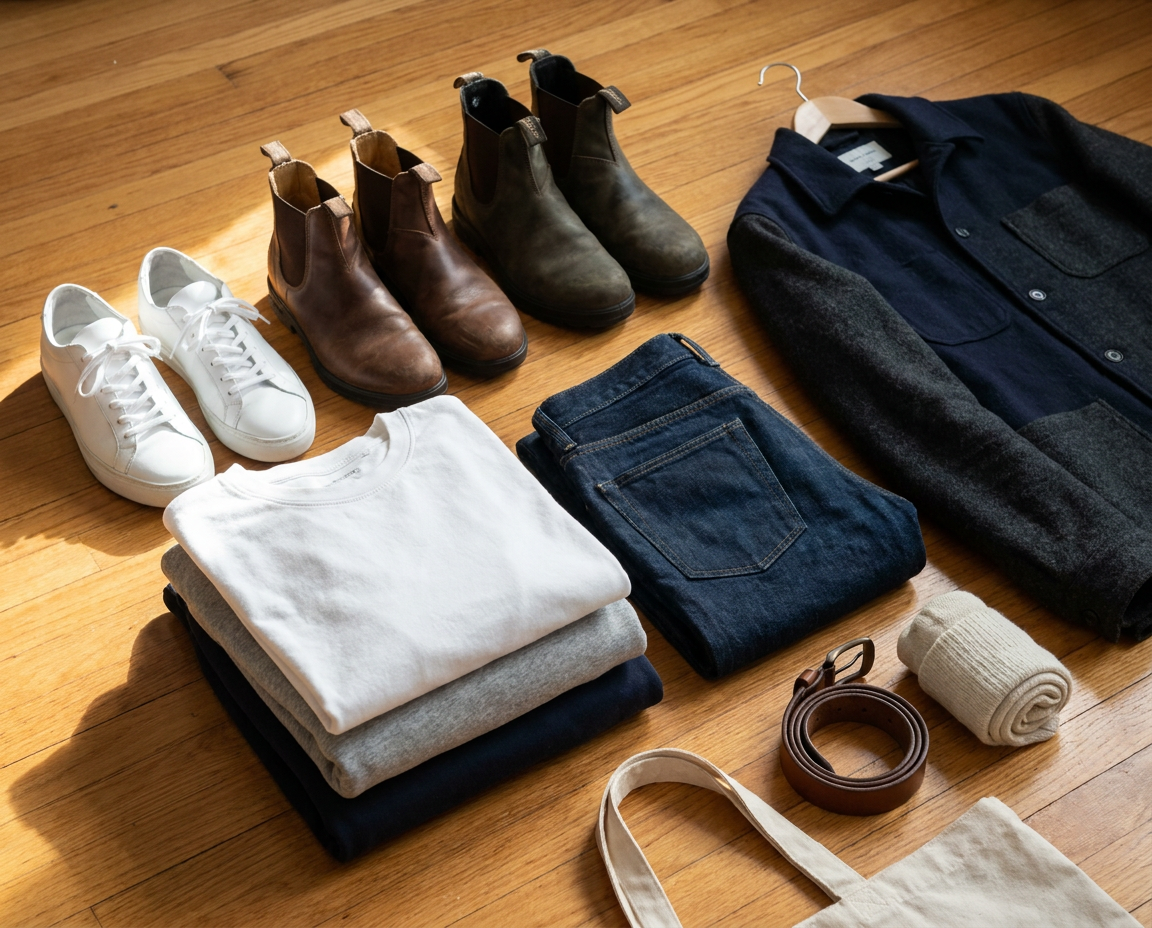
A cheap shirt that fits beats an expensive one that doesn’t, and most of my upgrades came from alterations rather than new purchases. A tailor hemmed my black trousers to graze the top of my shoe, and shortened the sleeves on a jacket I’d nearly donated. The jacket was fine all along. The hem on a pair of pants is the cheapest fix in clothing, usually costing a fraction of what the pants did.
Pay attention to fabric when you replace things. Cotton, wool, and denim last the longest in my closet. Merino crewnecks resist smell, so I wear mine three or four times before washing, cold, then dry flat. Polyester blends pill on me by the second season, and they make me sweat under a coat. I’m not against synthetics, since my rain shell is nylon, but I check the tag before anything goes into the cart.
Wash less. Jeans go through the machine only when they smell or have a visible stain, and I turn them inside out when they do. Sweaters get a cold wash and never touch the dryer. The longer a staple lasts, the less you spend replacing it, and that matters more than any sale.
My buying rule is the thirty-day wait. When I want something, I write it in my phone and look again a month later. About half the time I can’t remember why I wanted it. If it survives, I check it against the checklist: does it match two bottoms and two tops already here? If it doesn’t, it stays on the list or I skip it.
I also run a one-in, one-out policy. A new pair of boots means the old pair gets resoled for backup or leaves the house. Resoling usually costs less than replacing the boots, which is why I keep a cobbler’s number on my fridge.
Last month my white sneakers developed a crease across the toe box. I wiped them down, swapped the laces, and kept wearing them. Nobody said a word.