The Gray Crewneck Formula I Wore Four Days Running
I used to stand in front of my closet for ten minutes every morning, then leave in whatever was on top of the chair. A few years ago I started treating outfits like recipes: fixed ingredients, small swaps. Three formulas now cover almost every week I have, from office days to errands to a weekend trip. None of them need new clothes if you already own a pair of dark jeans and a plain tee.
The Tee, Overshirt, and Straight Jeans Stack

This is my default when I don’t know what the day holds. A heavyweight white tee, a chore coat or overshirt over it, dark straight-leg jeans, and white leather sneakers. That’s the whole formula, and I’ve worn it to coffee meetings, grocery runs, and a casual dinner with my in-laws.
The reason it repeats well is that each piece hides the others’ wear. A Hanes Beefy-T gets washed constantly and holds its shape, so it can be the fresh part while the overshirt carries the wrinkles. Mine is a tan canvas Carhartt that’s softened at the elbows. Swap it for a navy one, an olive one, or a denim shirt and the outfit reads as a different day.
Monday through Wednesday I rotate only the top layer. Monday it’s the tan chore coat. Tuesday it’s a light blue oxford worn open over the tee, sleeves pushed up. Wednesday it’s a gray quarter-zip. Same jeans, same shoes, same tee. People assume I changed everything, since the silhouette shifts when the outer piece does.
Fit is where this formula goes wrong. If the overshirt is too snug across the back, you’ll feel it every time you reach for a seatbelt. Try it on over a tee, not bare, and raise your arms. If the hem rides up past your belt line, go up a size. Jeans should be dark and plain, without rips or heavy fading, because texture is already coming from the canvas.
On cold mornings I put a navy merino crewneck between the tee and the overshirt. It adds a layer without bulk, and the collar peeking out looks deliberate. I wear it three or four times before washing, cold, then dry it flat.
Shoes can drift. White sneakers keep it casual, but brown leather Chelsea boots make the same outfit work for a slightly dressier setting. I’ve worn this exact combination with Blundstones to a client lunch and nobody blinked.
Monochrome Plus One Contrast Piece

The second formula is about color rather than clothes. I choose a single shade, usually gray or navy, and wear it head to toe in different textures. Then I add one piece in a contrasting tone, a white sneaker or a cream scarf, to break it up.
My go-to version is gray on gray. A heather gray sweatshirt, charcoal wool-blend trousers, and white leather sneakers as the contrast. The two grays aren’t identical, and that’s the point: a lighter top over a darker bottom looks intentional, while two near-matches look like a mistake. If the shades are almost the same, push one of them further apart.
Texture does the heavy lifting. A smooth sweatshirt against a flatter wool trouser reads richer than two flat cotton pieces. I add a canvas belt or a ribbed knit beanie when I want another surface without another color. Navy works the same way, with a navy merino sweater, navy chinos, and brown boots as the break.
This formula saves me on bad mornings because I can’t clash. Everything in the lineup already belongs together, so I reach into the gray pile and pull any top and any bottom. I keep my gray pieces on one shelf and the navy ones on another, which means I choose a shelf instead of an outfit.
Where it goes wrong is when everything is the same fabric and the same weight. Head-to-toe cotton jersey looks like pajamas. I mix at least two materials, such as wool and cotton, or knit and denim.
Shoes carry the contrast, so I keep one pair of white leather sneakers and one brown pair near the door. Dark socks disappear into the trousers, but I sometimes wear a bright pair, such as mustard Darn Tough ones, when the rest is quiet. Nobody sees them except me, and they make me smile when I sit down.
The one thing I’d skip is black head to toe on a gray winter day. It wipes me out. Charcoal and navy feel warmer on my skin tone, though that’s a personal call.
One Dressy Piece Over Everything Else

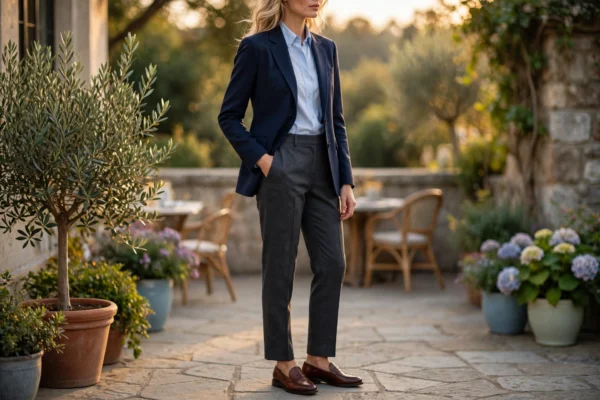
The third formula is for days when I need to look a little sharper without suiting up. I wear one dressy item and keep everything else relaxed. That one item is usually an unstructured navy blazer, though a charcoal overcoat does the same job in winter.
The rest stays simple: a white tee or a light blue oxford, dark jeans, and clean sneakers. The blazer does the talking, and the casual pieces stop it from looking like I’m headed to an interview I forgot to mention. Mine has no shoulder pads or stiff lining, so it feels like a cardigan and moves like one.
I wear it Thursday and Friday. Thursday is the blazer over a tee with dark jeans. Friday it goes over the oxford, collar open, with the black wool-blend trousers I normally save for evenings. Same jacket, different mood, and I haven’t had a comment yet that suggested I’d repeated it.
The rule is simple: one dressy item, everything else casual. If you add a blazer, leave the dress shoes at home. If you wear trousers, skip the blazer and let a sweater do the work. Matching two formal pieces and one casual one tips it toward a costume.
Fit matters more here than anywhere else. Shoulder seams should sit at the edge of your shoulder, and sleeves should stop where your wrist meets your hand, with a little cuff showing. A tailor can shorten sleeves, but shoulders can’t be fixed. I learned that after buying a blazer that was cheap and slightly too wide, and I wore it twice.
I also wear the blazer on trains and planes. It holds a passport, phone, and earbuds in its pockets, and it’s warmer than it looks. On a cold flight it doubles as a blanket.
Press it with a steamer or hang it in the bathroom while you shower. I’ve never needed to dry-clean mine more than once a year, usually after a wedding.